

Digital downloads represent a straightforward revenue model: create once, sell repeatedly. Yet most creators leave money on the table through poor positioning, weak product pages, and scattered distribution.
At Ailudus, we’ve observed that conversion rates for digital products typically range from 1–3%, while optimized funnels regularly hit 5–8%. The difference isn’t luck-it’s systematic testing and structural clarity. This post outlines the frameworks to sell digital downloads effectively by treating each stage of your funnel as a measurable system.
Understanding Your Digital Download Market
Know exactly who converts and why
Your first job is not to build a better product page-it’s to know exactly who converts and why. Most creators skip this step entirely, treating digital downloads as a generic category. They’re wrong. A $47 course appeals to different buyers than a $9 template pack, and both operate on different conversion mechanics than a $200 specialized framework. Map your actual buyers, not hypothetical ones. If you sell design templates, your buyer might be a freelance designer hitting a deadline, a small agency standardizing workflows, or an in-house designer justifying tool purchases to leadership. Each persona has different decision criteria, different objection patterns, and different price sensitivity.
Understanding buyer personas for digital downloads means segmenting your audience by behavior data, demographics, and measurable metrics rather than assumptions. A freelancer downloading a template has a different funnel than a team buyer, and your page copy, pricing, and follow-up should reflect that distinction.
Audit competitors to claim clear territory
Stop analyzing competitors generically. Instead, audit three to five direct competitors offering similar download formats at similar price points. Document their positioning statements, the problems they emphasize, their pricing tiers, and what social proof they display. You’ll notice patterns: some emphasize speed and convenience, others stress comprehensiveness or results, still others compete on price.
Your positioning strategy to differentiate from competitors must occupy clear territory-not the middle ground. If competitors position on affordability, competing on affordability too is a losing game. Instead, own a different axis: speed of implementation, depth of framework, specialized industry application, or outcome guarantees. This gap suggests that buyer intent matters more than volume. Your competitor analysis should identify which keywords and positioning statements attract the highest-intent buyers, then claim adjacent territory rather than occupying the same space.
Define the problem your download solves
Finally, define what your download actually solves. Not what it contains-what problem it removes. A template pack doesn’t sell templates; it sells relief from design work or standardization without hiring. A framework doesn’t sell methodology; it sells faster implementation and reduced decision fatigue. This clarity becomes your conversion foundation and shapes every decision that follows in your funnel structure.
Converting Browsers Into Buyers
Position your page for a single buyer
Your product page is where positioning meets persuasion. Most creators treat it as a specification sheet-features, file sizes, included assets. That approach fails. Your page must answer a specific question your buyer asks at the moment they land: will this solve my problem faster or better than the alternative I’m already considering?
The average conversion rate for digital downloads sits around 2.9% according to Ruler Analytics, but pages that isolate a single buyer persona and address their specific friction point regularly exceed 5%. The structural difference is measurable. Start by removing every element that doesn’t speak directly to your primary buyer’s decision criteria. If you sell design templates to freelancers, remove language about team collaboration features. If you sell frameworks to agencies, remove solo-operator testimonials. One page, one buyer, one decision path.
Deploy social proof that matches your buyer’s outcome
Social proof accelerates the buying decision, but only when it’s specific and relevant. Generic five-star reviews perform worse than a single case study showing a freelancer who completed a project 40% faster using your templates. Trusted reviews drive B2B purchasing decisions, but the review must match their situation.
A designer cares about speed and aesthetic quality; a project manager cares about standardization and team alignment. Your social proof should reflect the exact outcome your target buyer seeks. A testimonial from someone in their role, solving their problem, converts far more effectively than praise from a different buyer segment.
Test elements systematically before scaling
Testing reduces guesswork from conversion optimization. Heatmaps and session recordings from tools like Hotjar or Microsoft Clarity reveal precisely where visitors click, scroll, and abandon. Run these tools for two weeks on your product page before making changes-you’ll see patterns your intuition misses.
After baseline data, test one element at a time: headline, benefit statement, pricing presentation, or CTA button copy. The industry average form conversion rate is 1.7%, but segmented, persona-specific pages often achieve 2.5% or higher. This gap tells you that specificity matters more than polish.
Structure pricing to capture multiple buyer segments
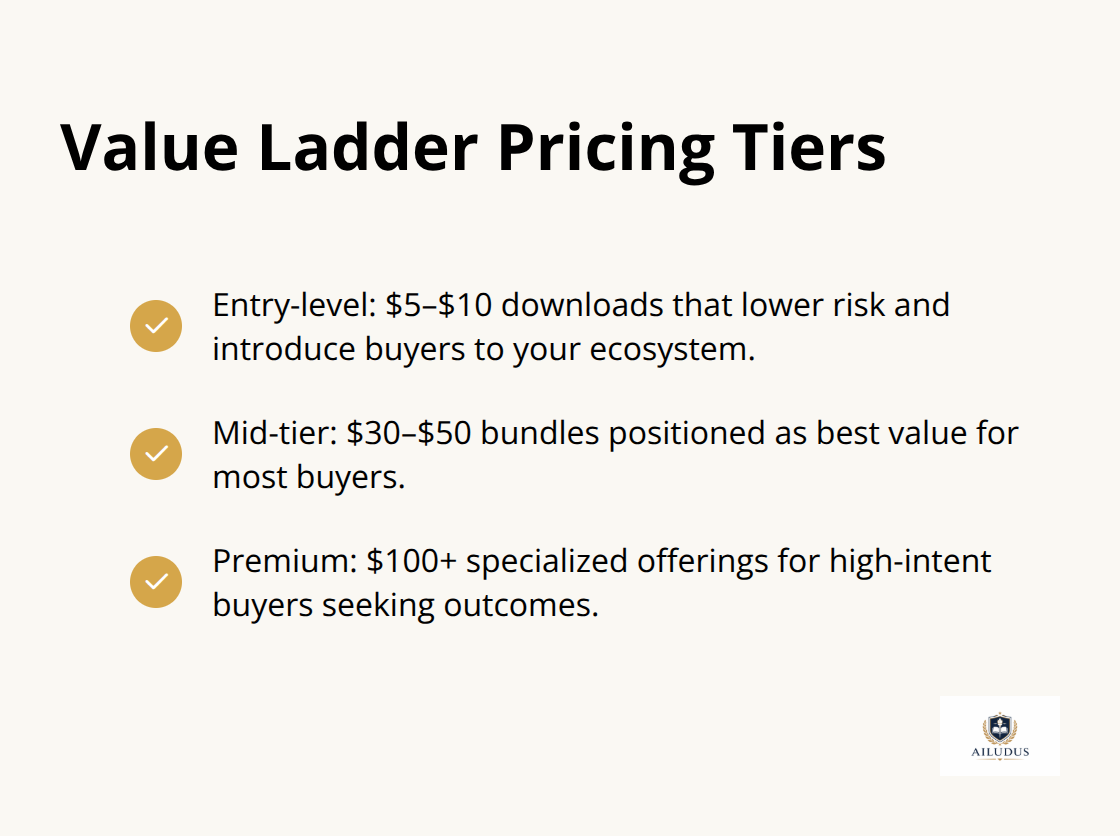
Pricing strategy matters more than most creators acknowledge. A value ladder approach-offering entry-level downloads at $5–$10, mid-tier bundles at $30–$50, and premium offerings at $100+-captures buyers with different budgets and primes lower-tier customers for future upsells. Dropbox used this structure to scale from free storage to enterprise solutions.
Your packaging should make the mid-tier option feel like the obvious choice. If you offer only one price, you leave revenue on the table; if you offer three poorly structured tiers, you confuse buyers into inaction. Test your pricing against competitor offerings and adjust quarterly based on conversion data and customer feedback, not assumptions about what the market will bear.
The mechanics of your product page determine whether visitors convert or abandon. Once you’ve built a page that converts, the next challenge is reaching the right buyers at scale-which requires a distribution strategy that matches where your audience actually spends attention.
Distribution Channels That Actually Drive Sales
Email: Your Most Reliable Revenue Channel
Email converts at 2.6% on average, making it your most reliable repeat-revenue channel for digital downloads. Most creators treat email as broadcast-weekly newsletters to their entire list. That approach leaves money on the table. Segment your list by purchase history and buyer stage instead. Customers who bought your $47 framework should receive different messaging than prospects who downloaded your free lead magnet. A buyer of design templates needs upsell offers for complementary template packs; a non-buyer needs objection-handling sequences that address why they abandoned the product page. Build these segments before you send the first campaign.
Mailchimp and ConvertKit both support conditional email sequences triggered by purchase behavior. Test your email frequency too-some audiences respond to weekly sends, others unsubscribe at that cadence. Start with biweekly campaigns and adjust based on unsubscribe rates and click-through data. Abandoned cart emails are non-negotiable: someone added your download to their cart but did not complete the purchase, meaning their objection is addressable. Send this email within two hours of abandonment. Mention the specific download they viewed, restate its core benefit relevant to their situation, and offer a limited-time discount if price was the barrier. This single tactic recovers 10–15% of abandoned carts in most digital product categories.
Organic Search: Authority That Converts at Scale
Organic search ranks second to email in conversion efficiency at 2.7%, but it requires you to build authority through content that ranks for high-intent keywords. This means you must publish articles that answer the questions your buyers ask before they’re ready to purchase. If you sell email marketing templates, rank for terms like “how to segment an email list” or “best practices for email automation.” These searches indicate someone actively solving a problem your template solves. Write detailed, instructional content that demonstrates expertise and links to your product page as a natural next step.
Ranking for competitive terms requires substantial backlinks, so plan an outreach strategy: reach out to industry publications, complementary tool blogs, and relevant communities to earn links to your content. This approach takes time but produces zero-marginal-cost traffic once your content ranks. The investment compounds over months and years, making organic search your most efficient long-term channel.
Paid Search: Capturing High-Intent Buyers
Paid search works best for high-intent keywords where someone explicitly searches for your product category. If you sell social media templates, bid on keywords like “social media post templates” or “Instagram template pack.” These searches show purchase intent. Set a daily budget of $10–$20 and track your cost per acquisition against your product margin. If your $27 template generates a 4% conversion rate from paid search at $0.80 per click, your customer acquisition cost sits around $20-profitable but thin.
Monitor your return on ad spend weekly and pause campaigns that fall below a 3:1 ratio. Paid search works best as a complement to organic search, not a replacement. Use it to test keywords and messaging before you invest in organic content that targets those same terms.
Retargeting: Converting the Audience That Almost Bought
Retargeting addresses the 97% of visitors who leave without buying. Deploy pixel-based retargeting on Facebook and Google to show your product to people who visited your page. Segment your retargeting audience: show a discount offer to people who visited the product page but did not buy, show upsell bundles to people who already purchased, show educational content to people who visited your landing page but did not reach the product page. This layered approach converts 2–3x better than generic retargeting.
Track your return on ad spend weekly and pause campaigns that fall below a 3:1 ratio. Retargeting works because it addresses objections at scale-someone visited your page, which means they already know your product exists. A second exposure with a different message (discount, social proof, or educational angle) often removes the final barrier to purchase.
Building a Self-Feeding Distribution System
The combination of email, organic search authority, and retargeting creates a distribution system that feeds itself: email captures repeat buyers, organic search brings qualified prospects at zero marginal cost once content ranks, and retargeting monetizes the audience that needs additional exposure to convert. Each channel reinforces the others. Customers acquired through paid search can be added to your email list for future upsells. Content that ranks organically can be repurposed into retargeting ad copy. Email subscribers who do not convert become retargeting audiences. This interconnected structure means you do not rely on any single channel-you build redundancy and resilience into your distribution.
Final Thoughts
Selling digital downloads effectively requires three structural decisions: knowing your buyer with precision, testing your conversion mechanics before scaling, and building a distribution system that compounds over time. The gap between a 2% conversion rate and a 5% rate stems not from better copywriting or flashier design, but from clarity about who converts, why they convert, and what removes friction from their decision. Your buyer persona determines everything downstream-a freelancer buying templates operates on different decision criteria than a team lead standardizing workflows, and your product page, pricing structure, email sequences, and retargeting messages must reflect this specificity.
Testing reveals what intuition misses. Heatmaps show where visitors abandon, A/B testing on headlines and pricing tiers identifies which messaging moves your audience, and email segmentation by purchase history outperforms broadcast sends. This data becomes your operating system; without it, you make decisions based on assumption rather than evidence. The distribution channels that work-email, organic search, paid search, and retargeting-function best when they reinforce each other, creating redundancy so you do not depend on any single channel.
Scale what works through systems, not shortcuts. Email automation, content calendars, keyword research workflows, and retargeting audience segmentation require upfront investment but produce returns that accelerate over time. Visit Ailudus to explore how systematic thinking applies to your digital product business.
— Published by Ailudus, the operating system for modern builders.