

Most entrepreneurs treat their business like a collection of tasks rather than a system. At Ailudus, we’ve found that the ones who scale fastest build operating systems for entrepreneurs-structured frameworks that separate decision-making from execution.
Your personal operating system is the difference between working in your business and building something that works without you. This post covers how to design one.
Core Components That Actually Work
A scalable operating system rests on three structural pillars working in concert: how you make decisions, how you document and automate what matters, and what tools sit underneath it all. Most entrepreneurs collapse these together. They build tools before they understand their decisions. They automate processes that shouldn’t exist. They treat software as strategy instead of infrastructure. The order matters. Decision-making frameworks come first because they shape what gets documented and which tools you actually need. Founders who reverse this sequence spend months in software that never produces leverage.
Decision-Making Protocols That Stick
Your decision-making framework is the skeleton of your operating system. Without it, every choice becomes a fresh debate, and your team (or your future self) spends energy re-litigating the same questions. Michael Hyatt’s framework from The Vision Driven Leader identifies four pillars worth anchoring decisions around: team, product or services, marketing, and impact. Each pillar generates different decision types. Should you hire another designer? That’s a team decision, shaped by whether this hire accelerates product velocity or marketing output.
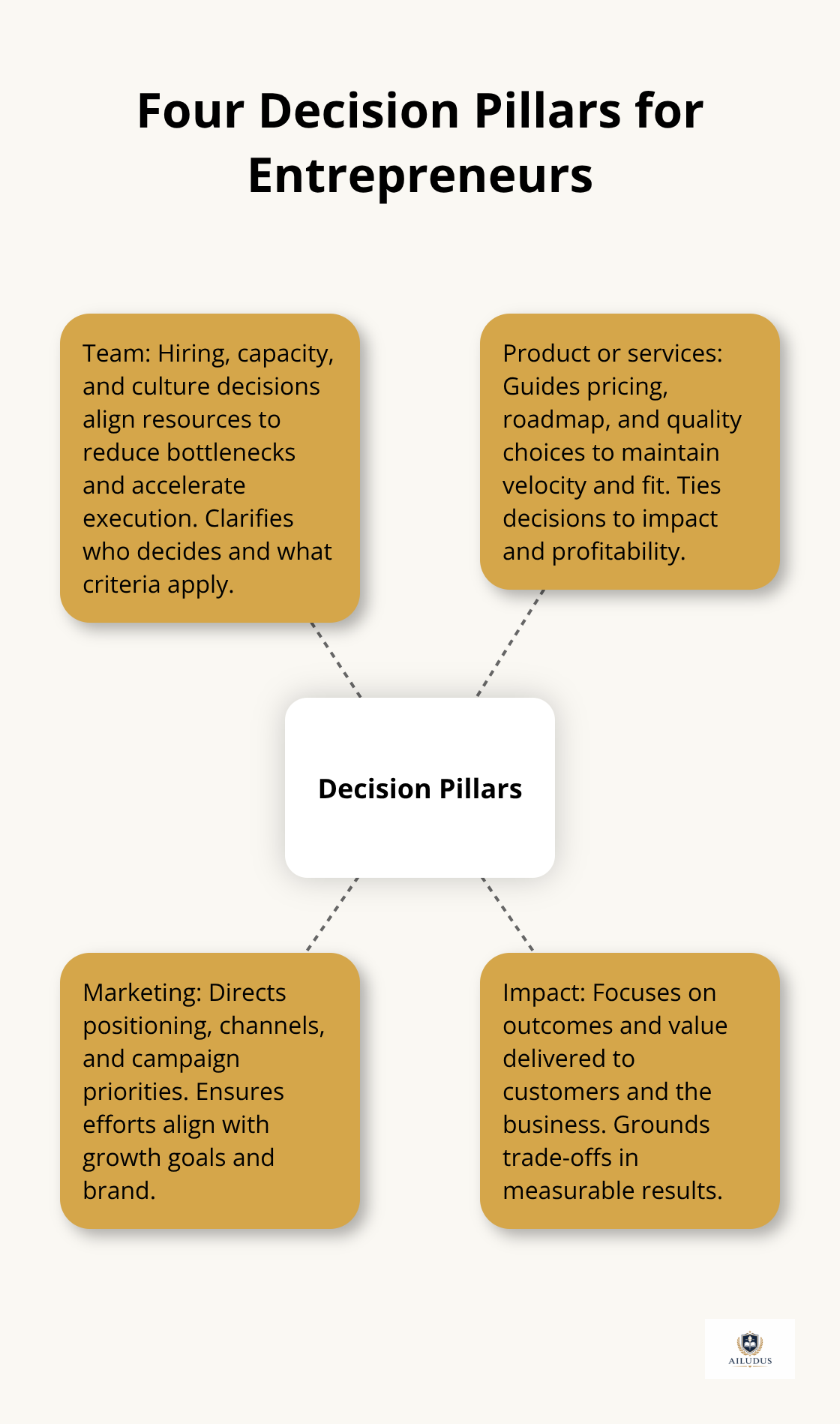
Should you pivot the pricing model? That’s product and impact. When you codify which pillar owns which decision, you stop making them in isolation.
Write down three to five decision criteria for each pillar and share them. Not as rigid rules, but as reference points. One founder uses a simple protocol: any hiring decision under $80,000 annually goes to the team lead with these criteria-does this person reduce bottlenecks, bring new capability, or improve culture? That’s it. No lengthy approval loops. The criteria exist, the owner is clear, and the decision sticks because it’s anchored to the system, not to the founder’s mood.
Documentation as Infrastructure
Process documentation is not busywork. It’s the difference between a business that depends on you and one that doesn’t. The EOS framework from Gino Wickman’s work emphasizes this: standardized processes for core routines make tasks repeatable and scalable. Most founders document only when forced. Start instead with the three to five processes that generate the most revenue or consume the most time. If you run client delivery, document that. If you manage supply chain or design briefs, start there. Not every process deserves a 50-page manual.
One operations leader uses a three-part standard: the decision tree (what triggers this process), the checklist (who does what, in order), and the exception protocol (what happens when something breaks). That’s the whole thing. Tools like Notion function well here as the organizational brain, turning decisions and lessons into structured, searchable knowledge that team members can actually reference. The real win comes when someone on your team completes a process without asking you a question. That’s documentation working.
Tools as Servants, Not Masters
The tool stack should follow process and decision architecture, never precede it. Too many entrepreneurs buy Asana or ClickUp or Notion first, then try to fit their work into the software’s logic. Reverse it. Once you know your decision frameworks and have documented your core processes, then choose infrastructure. Airtable works well for structured data and pipelines. Slack coordinates daily rhythms and preserves context in threads. Superhuman handles email triage at scale. ClickUp can support EOS components without being the entire system, acting as a central hub for rocks management, goal tracking, custom dashboards for scorecards, and task accountability.
The tool integration between tools matters more than any single application. Information should flow from your thinking space (where decisions live) into your execution space (where processes run) into your collaboration layer (where teams align). When that handoff breaks, you lose momentum. One scaled operator uses Tana as a personal command center for thinking and daily task management, Notion for organizational decisions, Airtable for cross-functional pipelines, and Slack as the nervous system. The tools themselves are interchangeable. The architecture isn’t.
These three pillars-decision protocols, documented processes, and aligned infrastructure-form the foundation. What separates systems that scale from those that stall is how you translate this foundation into actual leverage. That requires a deliberate separation between the skill you bring and the execution your system enables.
How Skill Becomes Leverage
Separating Your Judgment from Your Execution
Most entrepreneurs treat themselves as the execution layer. They build systems around their own genius rather than systems that work without them. The moment you become the bottleneck, your business stops scaling. Founders document processes, implement tools, run meetings-and still cannot delegate because the work requires their specific judgment or expertise. The issue isn’t the system architecture. It’s that they’ve confused skill with execution.
Your skill-pattern recognition, relationship-building, strategic judgment-should inform the system. It should not be the system. When a client delivery lead at a service firm understands the decision criteria for scope changes (does it affect timeline, profitability, or team capacity?), they make that call without escalating to the founder. The founder’s skill shaped the criteria. The execution doesn’t require them. This separation creates actual leverage.
One operations director tracks this explicitly: she lists which decisions require founder judgment versus which can run on protocol. Founder judgment handles strategy pivots, partnership terms, and hiring at the leadership level. Everything else-client onboarding, project kickoffs, resource allocation-runs on documented decision trees. She reviews these quarterly and moves decisions down the ladder when the team demonstrates consistency. That’s the real work.
Systematizing High Leverage Activities
High-value work generates disproportionate returns relative to time spent. Michael Hyatt’s framework from The Vision Driven Leader identifies these as High Leverage Activities. The method is straightforward: define your four pillars, list activities under each one using action verbs like recruit, launch, optimize, test, and then star the three that matter most. Don’t systematize everything. Systematize what moves the needle.
One founder systematized her customer discovery calls-the format, the questions, the note-taking protocol-and trained her team to run them. She still leads the strategic calls with major accounts, but 60 percent of customer interviews now happen without her.
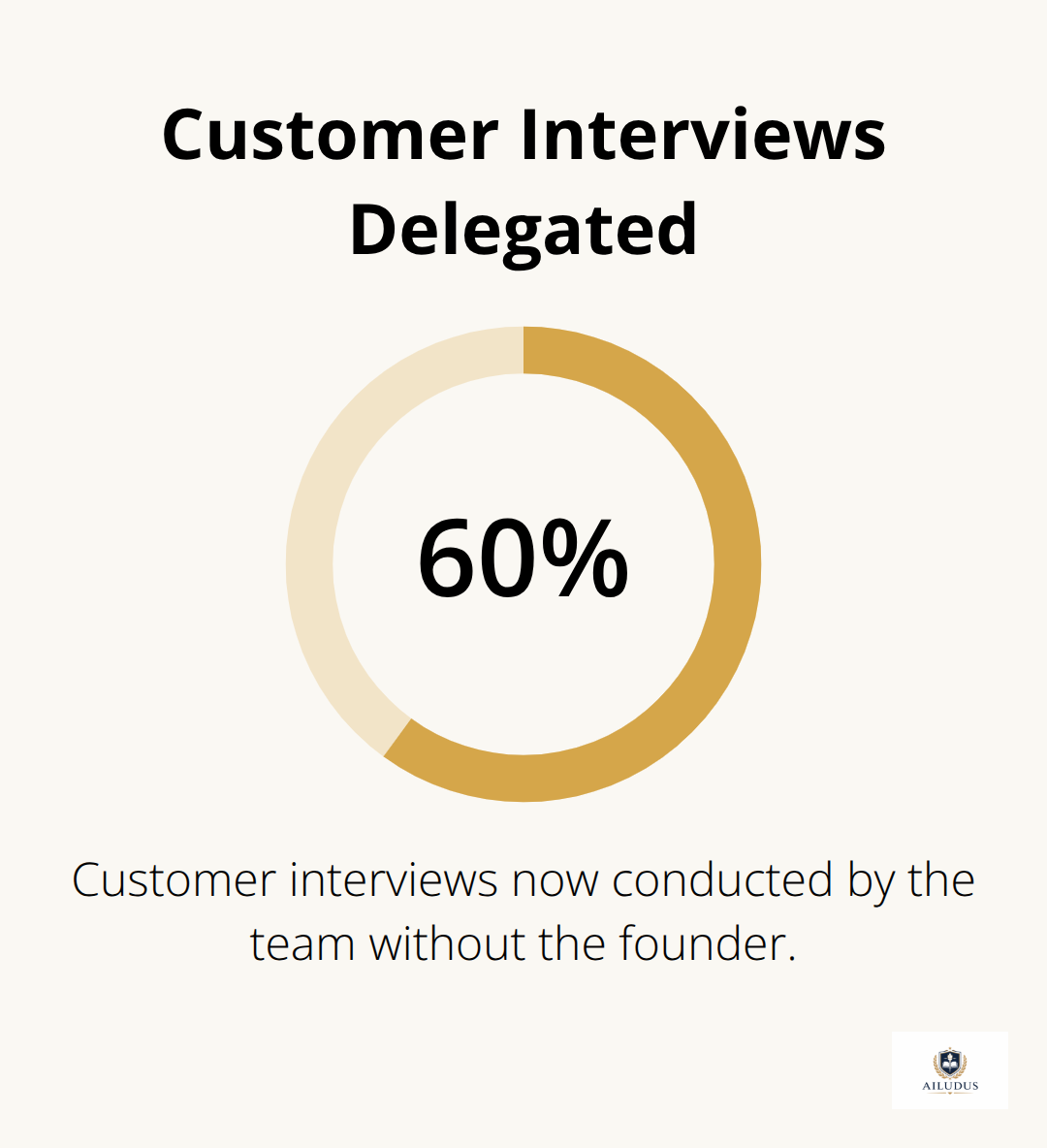
The process didn’t dilute the value; it multiplied her reach. The team executes at her level because the system captures her approach, not because they replicate her intuition.
Ownership Models That Enable Delegation
Ownership requires clarity on two fronts: who owns the outcome, and who owns the decision-making authority within that outcome. These are not the same thing. A marketing lead owns the quarterly lead target, but the copywriter owns how copy gets tested. A product lead owns the feature roadmap, but the designer owns the interaction decisions within scope. When ownership is ambiguous, you get either paralysis (everyone waits for approval) or chaos (everyone decides independently).
The EOS framework addresses this through what Gino Wickman calls Rocks-quarterly priorities with clear owners and deadlines. Each Rock has one owner responsible for hitting the target. That owner may delegate tasks, but they own the result. This distinction prevents the founder from becoming the owner of everything.
One scaled operator assigns Rocks using a simple question: who will this person report progress on in our weekly meeting? That person is the owner. They don’t need to approve every decision within that Rock. They need visibility and accountability. That’s structural delegation.
The next challenge emerges when these ownership models meet reality. Teams execute better when they understand not just what they own, but how their decisions connect to the broader system. That connection requires a different kind of infrastructure-one that surfaces problems before they cascade and keeps the whole operation aligned without constant founder intervention.
Where Systems Fail in Practice
The most common failure happens before you write a single line of code or buy a single tool. Founders build elaborate systems for processes that don’t yet exist or don’t matter. They design approval workflows for decisions that should be automatic. They create dashboards that track metrics nobody acts on. They implement software for operations that still require constant founder intervention. This happens because system design feels productive-it looks like progress-while validating process needs feels slow. The cost compounds quietly. You spend weeks configuring Airtable pipelines for a sales process that changes monthly. You document a client onboarding sequence that your team abandons because it doesn’t match how clients actually behave. You build a decision matrix for hiring that nobody references because the criteria don’t reflect your actual values. The real work is harder: run the process manually first, measure where it actually breaks, then systematize only what’s broken. One founder spent two months designing a resource allocation system before running a single project. When she finally started projects, the system addressed problems that didn’t exist and missed the real bottleneck: her team didn’t understand how to estimate work accurately. The system was solving for the wrong problem. Start with three to five cycles of a process running entirely on improvisation and notes. Document what actually happened, not what you think should happen. Identify the three friction points that appear consistently. Only then build the system around those specific failures. This approach costs more time upfront and saves months of wasted infrastructure.
Software Cannot Replace Thinking
The second failure treats software as a substitute for thinking. Founders adopt EOS or OKRs or some other framework, then assume the tool executes the framework. Notion doesn’t create clarity; it stores clarity you’ve already built. ClickUp doesn’t enforce accountability; it surfaces accountability you’ve already designed. Slack doesn’t align teams; it channels communication you’ve already structured. The framework lives in your decisions and processes. The tool merely reflects them. When a team fails to hit quarterly Rocks, the problem isn’t that they used the wrong platform. The problem is that ownership wasn’t clear, the Rock wasn’t tied to actual business outcomes, or the weekly check-ins weren’t real enough to catch drift early. Switching to a different EOS tool won’t fix this. Founders move from Traction Tools to Ninety.io to AgilityPortal, expecting each platform to magically enforce discipline. None of them do. The discipline comes from the founder and the team showing up to weekly meetings, reviewing actual progress against targets, and making hard calls about what changes. The tool is incidental. This distinction matters because it shapes where you invest energy. If your team isn’t executing, buying better software is the wrong move. Revisiting your decision protocols, clarifying who owns what, and running tighter accountability meetings is the right move. The tool follows.
Knowledge Transfer Requires Reasoning, Not Just Steps
The third failure emerges slowly and costs the most. Founders document processes but fail to transfer the reasoning behind them. A checklist exists, but the team doesn’t understand when to break the checklist or what trade-offs it represents. Documentation becomes cargo cult: people follow steps without judgment. The moment something unexpected happens, execution stops and someone pages the founder. This happens because most documentation captures the what and the how, but not the why. One operations team at a service firm had a detailed client onboarding checklist. When a client requested a non-standard workflow, the team escalated to the founder instead of adapting. The founder had built flexibility into her mental model but never encoded it into the documentation. The checklist was rigid because the reasoning wasn’t visible. The fix requires a different documentation standard. Include the decision tree: what conditions trigger this process, and what conditions change how you execute it. Include the constraints: what are the non-negotiables, and where do you have latitude.
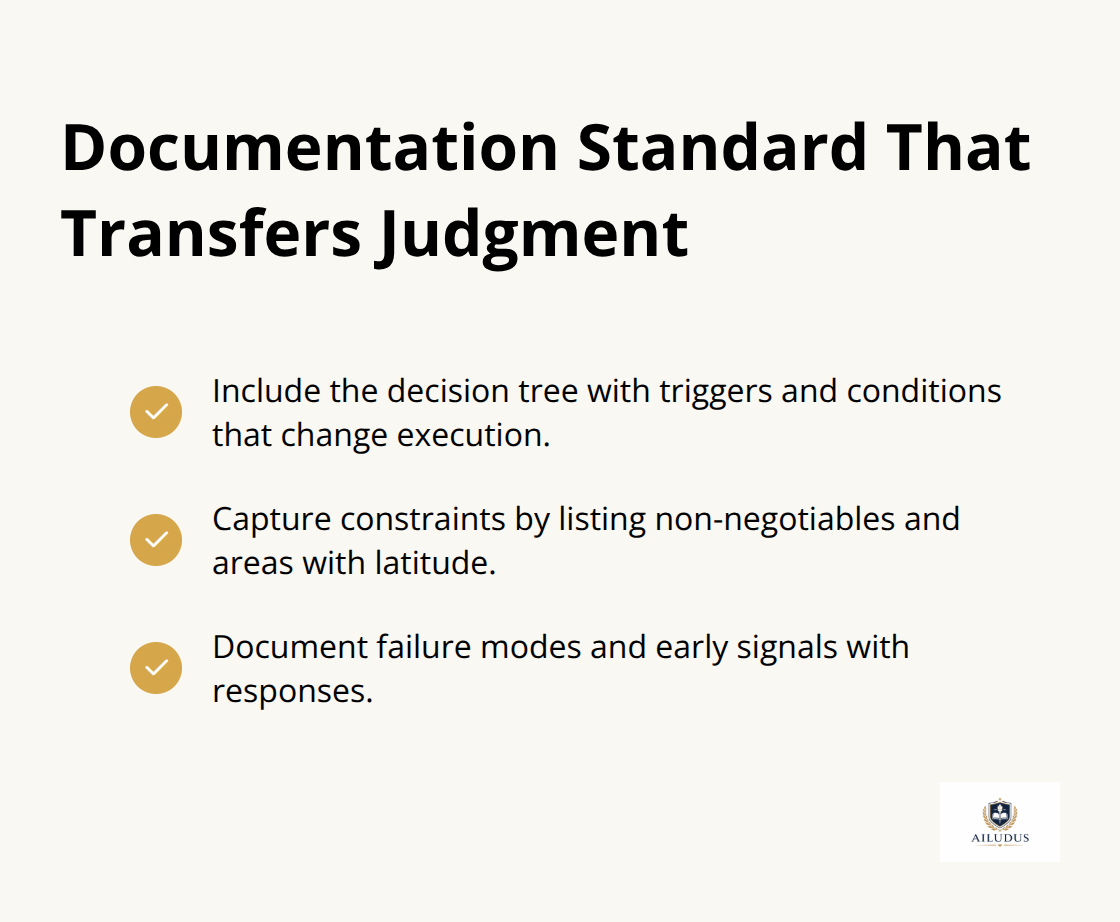
Include the failure modes: what typically goes wrong, and how do you recognize it early. One operator uses a simple format for every documented process: the objective in one sentence, the decision triggers that start the process, the sequential steps with decision points embedded, and three to five common exceptions with how to handle them. That’s the whole thing, and it takes an hour to document. When new team members read it, they understand not just what to do but why certain decisions matter and when they have permission to improvise. Knowledge transfer also requires showing the work, not just the output. When a founder makes a decision about scope changes or resource allocation, explaining the reasoning to the team takes five extra minutes. That five minutes becomes part of your culture and your documentation. Your team learns not to replicate your exact decision, but to replicate your decision-making process. That’s the shift from a business dependent on one person to a business that scales because multiple people can think like the founder.
Final Thoughts
Your operating system for entrepreneurs compounds in value as your business scales. The frameworks, processes, and decision protocols you establish today become the foundation that allows you to scale without proportionally scaling your own effort. Most founders treat system design as a project to complete, then move on-the ones who build durable leverage treat it as ongoing infrastructure maintenance that you revisit quarterly, measure against reality, and adjust when team capacity shifts.
Start small with one decision framework, one core process, and one tool that connects them. Run it for a month, measure what breaks, and adjust before you add anything else. This pace feels slow because it is, yet it produces systems people actually use instead of elaborate infrastructure that nobody follows because it doesn’t match how work really happens.
We at Ailudus have found that the shift from founder-dependent execution to system-enabled execution is where real scaling begins. Our recommended instruments guide covers the tools and frameworks that support this work, and the system you build today becomes the competitive advantage that allows you to compound tomorrow.
— Published by Ailudus, the operating system for modern builders.