

Running a solo business means wearing every hat at once. You handle marketing, customer service, product development, and finances-often with limited time and budget.
AI platforms for solopreneurs can change this. The right tools automate repetitive work, generate content faster, and help you manage customers without hiring a team. Here at Tools.Cloud, we’ve seen solopreneurs cut their workload in half while scaling revenue.
This guide shows you what to look for in an AI platform and how to implement one that actually fits your business.
What Solopreneurs Actually Need from AI
Solopreneurs don’t need AI for the sake of having AI. You need platforms that solve the specific problems draining your time and money right now. The most common bottleneck we see is this: you manually handle tasks that should be automated, create content one piece at a time instead of at scale, and lose potential customers because you lack the systems to capture and nurture leads. An effective AI platform removes these friction points without adding complexity.
Time you get back matters more than features you’ll never use
Solopreneurs lose over 7 hours per week on repetitive work-scheduling social posts, responding to routine emails, formatting documents, organizing files, and chasing down information buried in old messages. Tools like Zapier and Airtable automate content ingestion so new articles or resources flow into a centralized hub without manual data entry. AI meeting assistants such as Fireflies.ai or Otter.ai record calls, transcribe them automatically, and surface action items so you don’t spend an hour taking notes after each customer conversation.
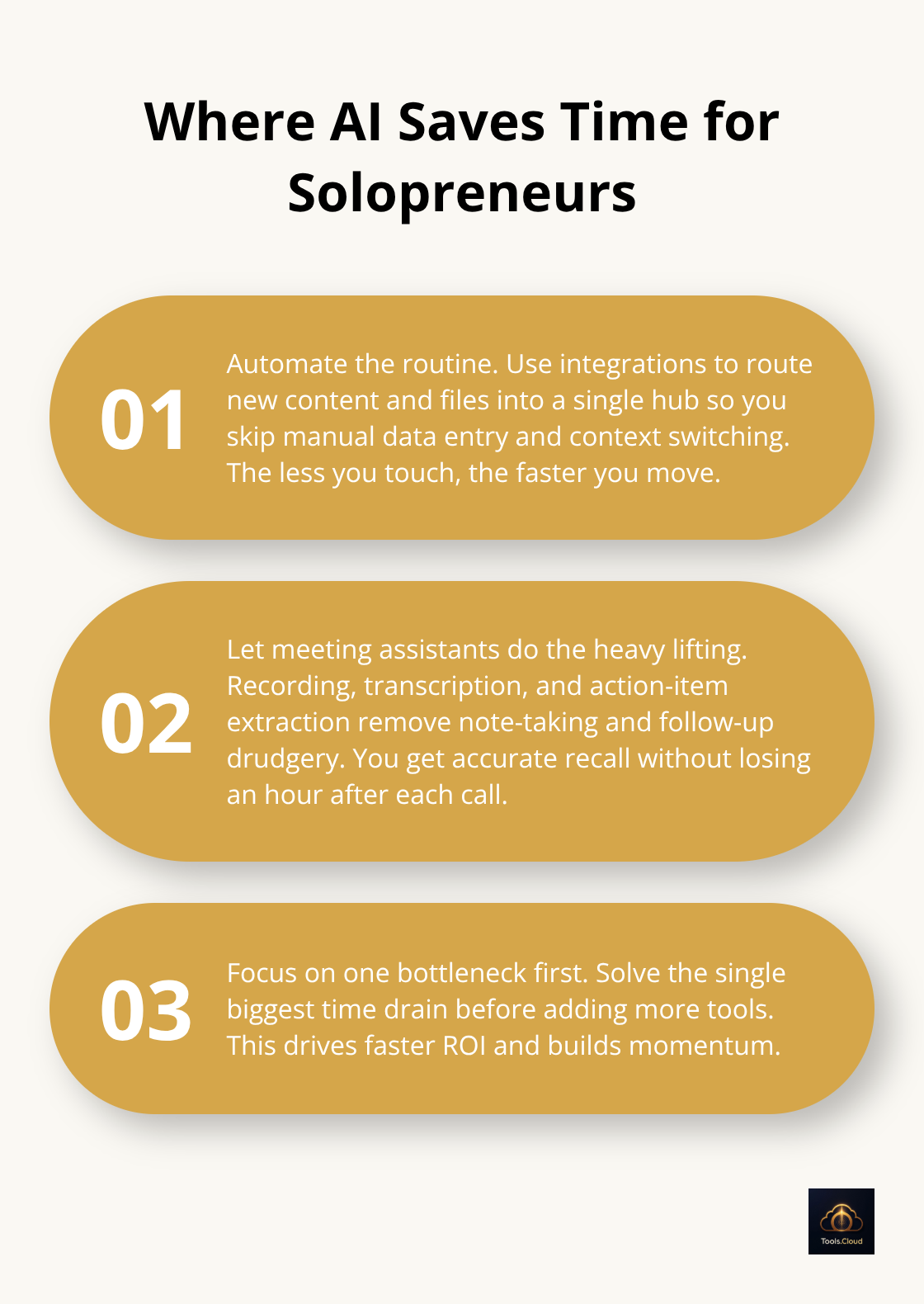
The real win isn’t the feature itself; it’s the 5-10 hours per week you reclaim to focus on revenue-generating work. Start with your single biggest time drain-not three problems, just one-and find a tool that specifically solves it. You’ll see ROI faster and build momentum to expand from there.
Content creation at scale requires smart repurposing, not more tools
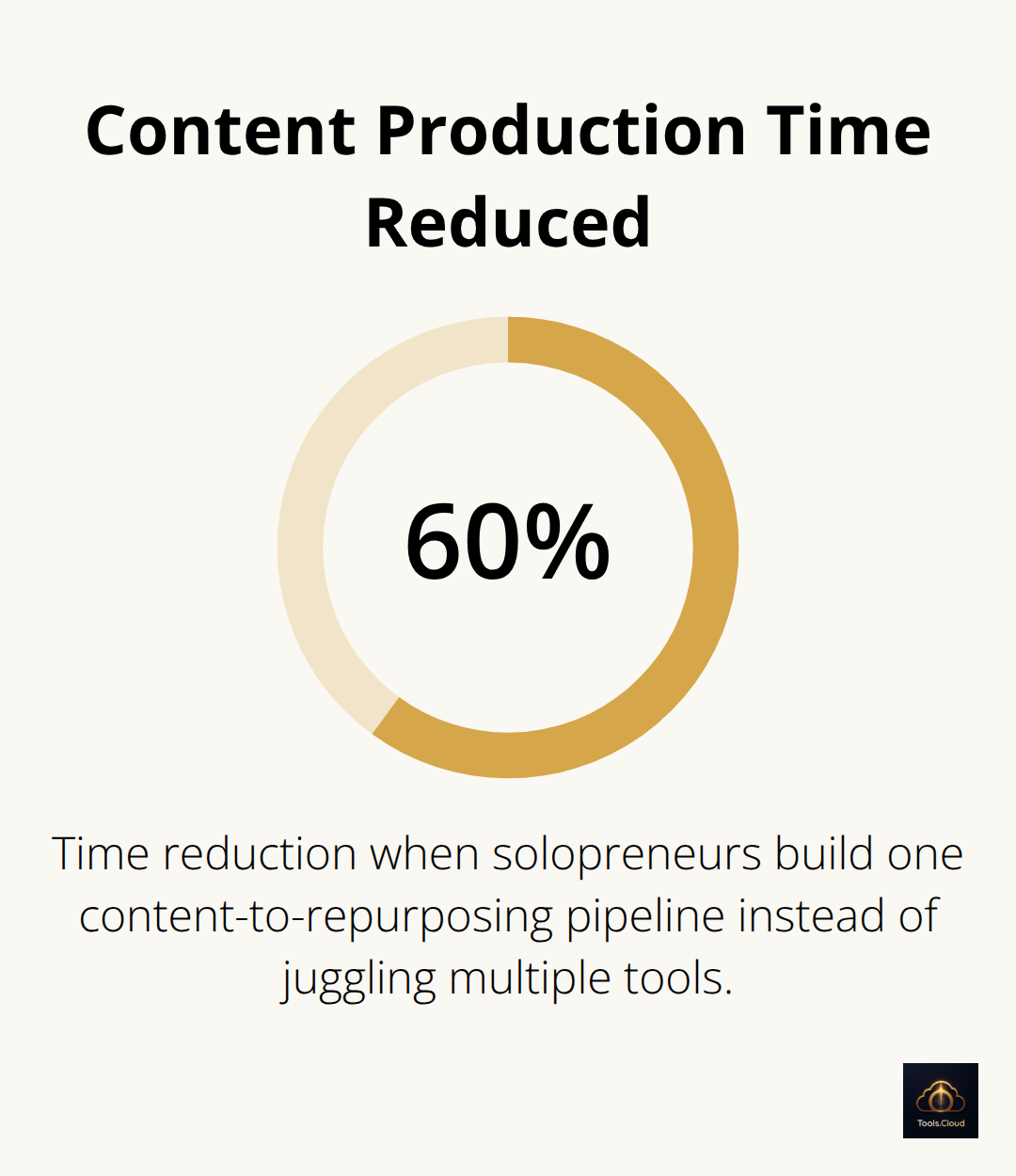
You don’t need five different AI writing tools. You need one system that turns a single piece of content into multiple formats for different platforms. A blog post should become social posts, a newsletter, a video script, and carousel graphics-all from the same source material. ChatGPT with Custom GPTs handles this well if you supply clear audience context and example posts, then edit the first draft to maintain your voice. Midjourney or DALL-E can replace stock photos with AI-generated visuals that match your brand identity (though consistency across outputs takes iteration). The workflow that actually works is this: create once, repurpose everywhere. Tools like Airtable combined with Zapier tag and categorize content automatically, so publishing workflows move faster and analytics data stays organized. Solopreneurs who skip the “create multiple tools” trap and instead build a single content-to-repurposing pipeline cut their content production time by 60% while maintaining quality.
Lead capture and customer management can’t be an afterthought
Revenue happens when you convert interested people into paying customers, but most solopreneurs treat lead management as optional. AI-powered invoicing tools like Zoho Invoice automate payment tracking and compliance starting at $25 per month. More importantly, you need email automation that nurtures leads while you sleep-Hootsuite Professional at $99 per month can schedule social posts and analyze audience engagement, but you also need a system that moves interested prospects into a sequence without manual follow-up. No-code AI agents handle customer service questions and e-commerce recommendations without coding, which means you stay responsive without spending hours answering the same question repeatedly. The solopreneurs who scale fastest aren’t the ones with the biggest audiences; they’re the ones who capture every lead, automate the nurturing sequence, and let AI handle the repetitive conversations.
The platform you choose shapes your entire workflow
Selecting the right AI platform determines whether you gain efficiency or add more complexity to your day. A unified dashboard eliminates the friction of switching between apps (email, CRM, content creation, analytics). Built-in AI assistants for writing, design, and strategy mean you don’t need to learn five different tools or pay five different subscriptions. The best platforms integrate lead management with email automation and revenue tracking so your entire customer journey lives in one place. This integration matters because solopreneurs who consolidate their tools report higher completion rates on projects and faster decision-making. Your next step is to assess which specific capabilities would eliminate your biggest operational bottleneck.
Which Platform Features Actually Move the Needle
A unified dashboard eliminates the context-switching tax
Switching between email, content creation, analytics, and CRM tools costs you an average of 9.5 minutes per switch according to research on task-switching costs. That friction adds up to 5-8 hours weekly just moving information between disconnected systems. Tools like Zoho Invoice integrate payment tracking directly into your workflow so you don’t open a separate app to check invoice status. Hootsuite Professional consolidates social scheduling and audience engagement in one place at $99 per month, which lets you batch your posting work instead of scattering it across the day.
The real test isn’t whether a platform has many features-it’s whether the features you actually use talk to each other. If your lead capture flows automatically into your email sequence and your email metrics feed back into your CRM without manual data entry, you’ve eliminated friction. A platform where your content creation, lead management, and customer communication live together removes that waste entirely.
AI assistants work best when they match your voice and business model
Generic ChatGPT outputs look and sound like everyone else’s content, which defeats the purpose of personal branding. When AI tools integrate directly into your workflow-suggesting subject lines as you draft emails, generating design variations as you build landing pages, or surfacing relevant customer data as you plan your next campaign-they become force multipliers instead of distractions. These suggestions appear exactly when you need them, without forcing you to switch contexts.
The platform you select should make it harder to do things wrong than to do them right. AI assistants tuned to your specific voice and business model turn generic outputs into branded assets that stand out.
Lead management and email automation create the real competitive advantage
Email automation paired with lead management drives the results that matter. A prospect opts in, gets automatically segmented based on their behavior, receives personalized nurture sequences, and moves to sales only when ready. Solopreneurs who use platforms where lead capture, email, and customer data flow together in real time report conversion rates 40-60% higher than those managing these functions separately.
This integration matters because your entire customer journey lives in one place. You capture every lead, automate the nurturing sequence, and let AI handle the repetitive conversations-all without manual follow-up. The solopreneurs who scale fastest aren’t the ones with the biggest audiences; they’re the ones who consolidate their tools and let the system work for them.
Your next step is to assess which specific capabilities would eliminate your biggest operational bottleneck and then test platforms before committing to a full subscription.
How to Pick an AI Platform That Actually Fits Your Business
Map your workflow bottlenecks before evaluating tools
Start by examining your calendar from the last two weeks and flag every task that felt repetitive, frustrating, or pulled you away from revenue work. Most solopreneurs waste time in three areas: content production (writing multiple versions for different platforms), customer communication (answering the same questions repeatedly), or administrative overhead (invoice tracking, scheduling, data entry). Write down the specific pain point that costs you the most time or money each week. This becomes your selection criteria. When you test platforms, ignore flashy features that sound impressive but don’t address your actual problem. A platform with 50 features you’ll never use wastes more time than it saves because you’ll spend weeks learning the interface instead of shipping work.
Test platforms with real workflows, not hypothetical scenarios
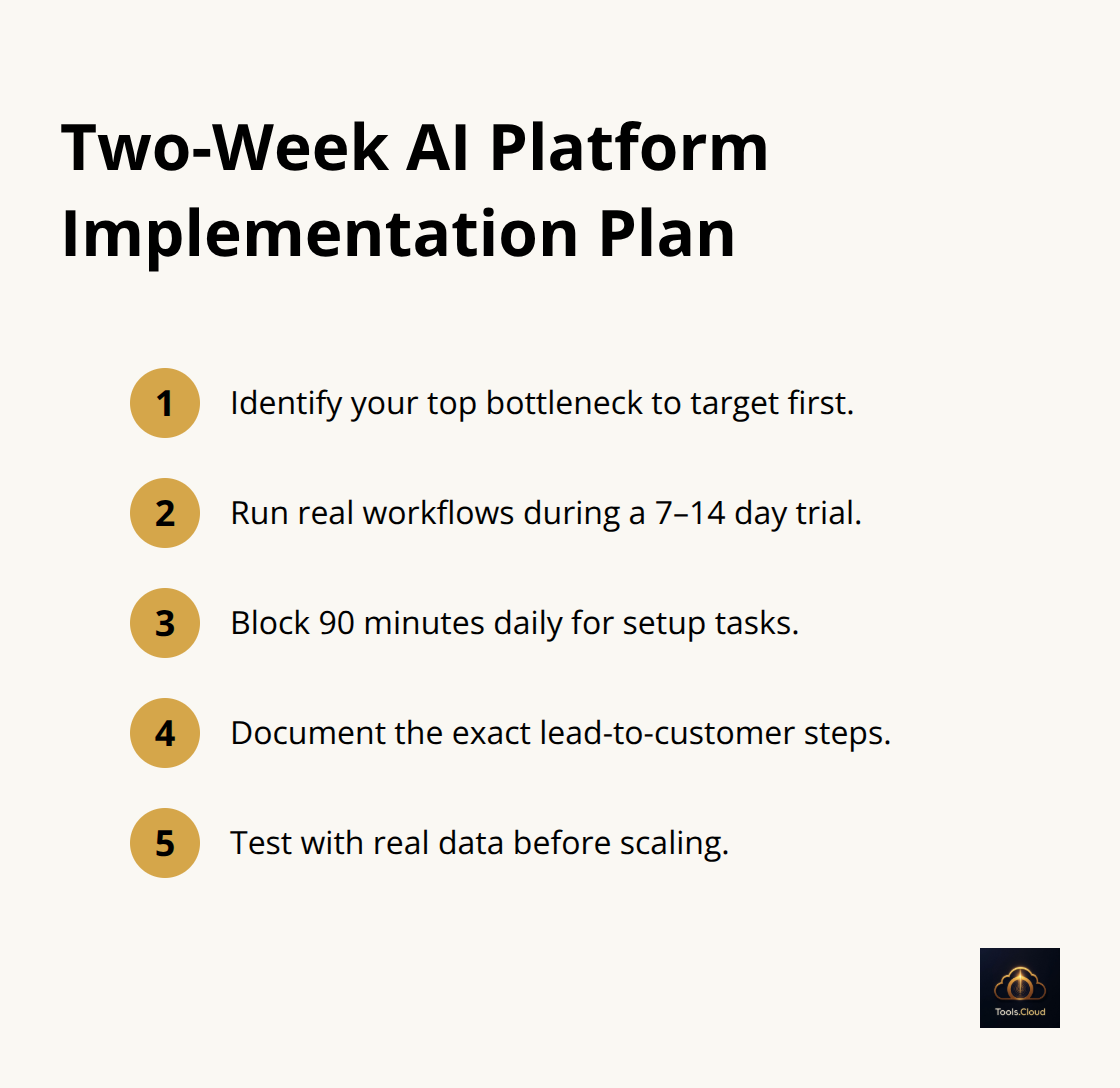
Most platforms offer free trials or limited free tiers that let you run actual work through them for 7-14 days without paying. Use this period to test your exact workflow, not imaginary use cases. If you’re a content creator, upload a draft blog post and see if the repurposing workflow actually produces usable social posts or if you’ll spend hours editing AI outputs. If you manage clients, process a real customer inquiry through the lead capture and email automation to see if the handoff feels natural. Tools.Cloud lets you build a complete funnel and publish content during the trial so you experience the actual system, not just a demo.
Time yourself during testing. How many steps does it take to move a lead from capture to email sequence? Can you schedule a week of social posts in under 30 minutes? Does the dashboard surface the metrics you care about without clicking through five menus? These small friction points compound into hours of wasted time monthly. After your trial, make a simple decision: does this platform eliminate your primary bottleneck without creating new ones? If the answer is no, move to the next option. If yes, commit to a 30-day paid subscription and build your actual workflow inside it.
Create a two-week implementation timeline
Implementation fails when solopreneurs expect instant results without planning the transition. Spread your setup across two weeks rather than trying to migrate everything in one weekend. Week one focuses on the core functions that generate revenue: lead capture, email automation, and customer communication. Week two adds content creation and publishing workflows.
This sequencing matters because you need revenue-generating systems running smoothly before you optimize content production.
Assign yourself 90 minutes daily for setup, not eight-hour blocks. Short, focused sessions prevent overwhelm and let you apply what you learned before moving to the next feature. Document your workflow as you go. Write down the exact steps you take to move a prospect from lead to customer, then map those steps inside the platform. This documentation becomes your training manual if you eventually hire help or need to troubleshoot issues.
Test each workflow with real data and actual material
Process an actual customer inquiry, send a real email sequence, and publish real content. Small problems reveal themselves immediately when you work with actual material rather than sample data. Most solopreneurs who struggle with new platforms skipped this step and tried to learn from tutorials instead of hands-on work.
Your first 30 days should feel slightly uncomfortable because you’re learning. Your second 30 days should feel noticeably faster because the system handles work that previously drained your time. The friction you experience early on transforms into efficiency gains that compound over months.
Final Thoughts
The solopreneurs who scale fastest consolidate their systems and let one platform handle the work that previously scattered across five different apps. AI platforms for solopreneurs work best when they eliminate context-switching, automate revenue-generating tasks, and keep your entire business in one place. A unified platform beats disconnected tools because your lead capture flows directly into email sequences, your content creation connects to publishing and analytics, and your customer data informs every decision without manual data entry.
When these systems talk to each other, you reclaim the 5-10 hours weekly that most solopreneurs lose to switching between apps and manually moving information between tools. The essential capabilities you need are straightforward: automation that removes repetitive work, content creation that scales without requiring five different subscriptions, and lead management paired with email automation so no prospect falls through the cracks. Everything else is secondary.
A platform that delivers these three things will transform your business faster than adding more tools ever will. Tools.Cloud gives you everything you need in one operating system to build your brand, create content at scale, manage leads, and deploy AI assistants without juggling disconnected apps. Start with your biggest bottleneck, test the platform with real workflows, and commit to a 30-day implementation.