

Most builders treat time as the problem. They’re wrong. Attention is what actually runs out first, and without it, more hours just mean more wasted motion.
At Ailudus, we’ve found that modern work discipline isn’t about squeezing more productivity from your day. It’s about building systems that protect your focus and turn consistent output into compounding leverage.
What Actually Runs Out First
The standard productivity advice tells you to manage your time better. Wake earlier. Block your calendar. Use a time-tracking app. The assumption embedded in all of this is that time is the scarce resource you need to optimize. It isn’t. Knowledge workers in technical and creative fields have roughly the same 24 hours as everyone else, but what separates high-output builders from those spinning their wheels is not hours logged-it’s attention capacity and how they allocate it.
Research from Ramírez and Nembhard on knowledge worker productivity shows that traditional input-output models fail because knowledge work lacks fixed production standards. You cannot simply add more hours and expect proportional output. A software engineer working 12 distracted hours produces less value than one working 4 hours of deep focus. The real constraint is cognitive capacity. Your attention, decision-making bandwidth, and ability to enter states of concentration are finite. Once those exhaust, additional time becomes friction.
Notification overload, meeting proliferation, and context switching deplete focus faster than physical fatigue depletes energy. Track your actual focus time for a week and you’ll likely find it runs between 2 and 4 hours per day, even if you’re at your desk for 10. That gap isn’t laziness-it’s the cost of modern digital work environments designed to interrupt you.
Why Time Management Systems Collapse
Traditional time management systems assume you control your schedule. For most builders, you don’t. Meetings appear. Slack demands responses. Clients request changes. The system breaks because it ignores the reality that attention is what you actually manage, not time.
Cal Newport’s research on deep work establishes that professional activity performed in distraction-free concentration pushes cognitive capabilities to their limit and creates new value, while shallow work-reactive, non-cognitively demanding tasks-is easy to replicate and creates nothing. The practical deep work ceiling is about 2–4 hours per day. Most builders never reach it because they’ve optimized for availability instead of output.
They respond to every message within minutes, attend every meeting, and keep their calendar open. They’re busy and feel productive, but they produce little of substance.
The Structural Shift Required
The shift required is structural: move from protecting time to protecting attention. This means making yourself inaccessible during focus blocks, batching shallow work into designated windows, and treating deep work as non-negotiable.
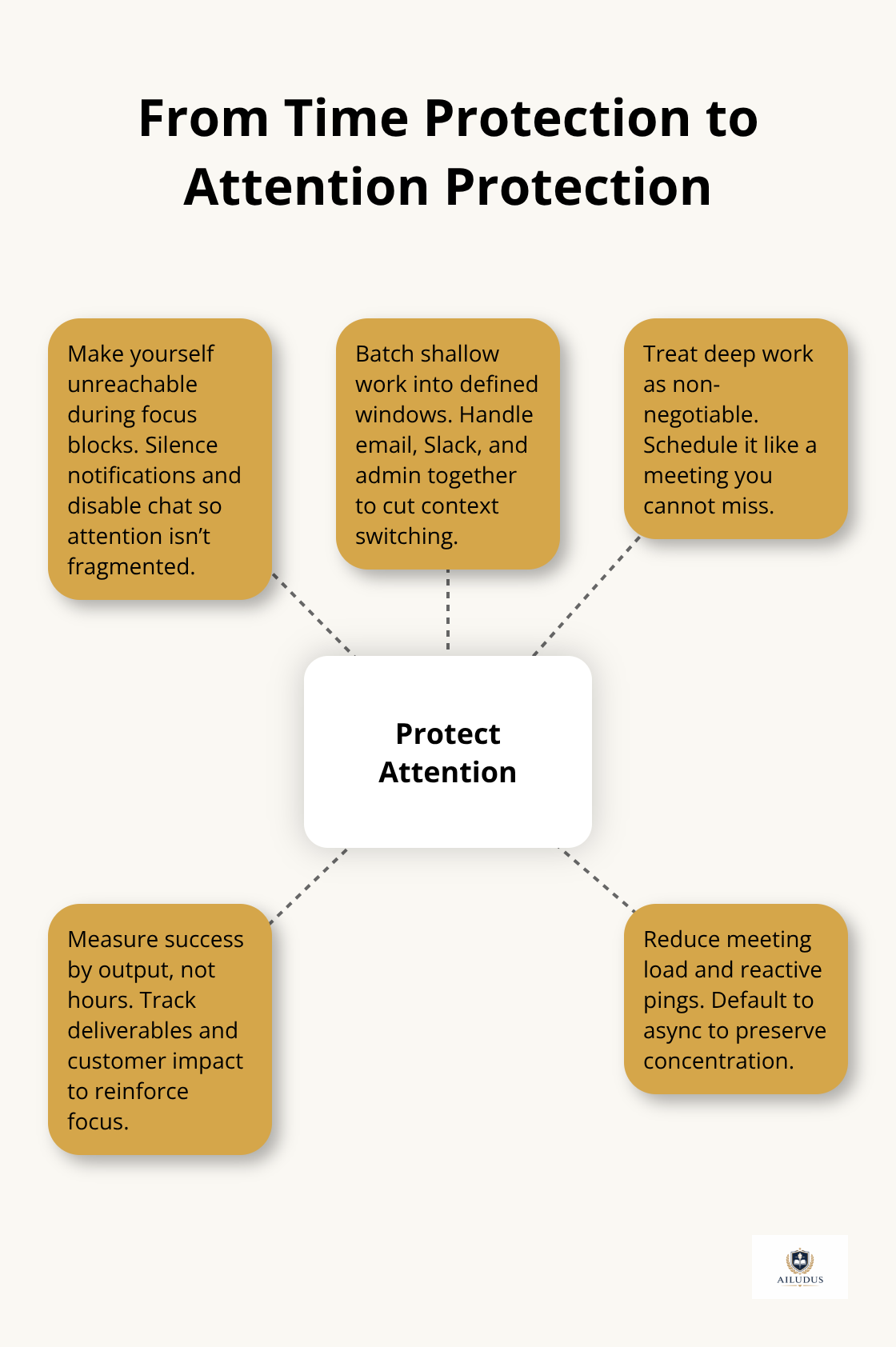
It also means measuring success differently. Instead of hours worked, track deliverables, customer impact, and quality of output. Shift the feedback loop from effort to results. When a team member completes a critical project in 6 focused hours instead of spreading it across 15 interrupted hours, that’s the metric that matters.
This reframing exposes why traditional productivity culture fails builders. You cannot optimize your way out of a broken system. You must build a new one-one where attention protection becomes the operating principle and output becomes the measure of contribution. The next section examines how to design the environment and structure that make this possible.
Building Systems for Sustained Focus
Your environment either defends your focus or destroys it. Most builders inherit their working conditions rather than design them. You sit where you’ve always sat, use the tools your organization chose, and accept the interruption patterns that emerge. This passivity costs you 2–4 hours of focus time weekly, compounded across months into lost leverage. The first structural move is environmental design: ruthlessly eliminate interruption sources during focus blocks.
Designing Your Operating Environment
Close Slack. Silence notifications. Make yourself unreachable for defined windows. Research on notification overload shows that interruptions fragment attention and increase stress, which directly correlates with reduced focus time. If you work in an open office, move to a private space, use noise-canceling headphones, or work during off-peak hours when traffic is low. The cost of finding a better environment is always lower than the cost of perpetual distraction.
Next, consolidate your tools. Every tool switch is a context break. If you toggle between email, Slack, a project management system, your notes app, and a code editor, you’ve fractured your attention before you’ve started real work. Audit your tool stack: which applications genuinely advance your goals, and which create busy work or duplication? Most builders accumulate tools incrementally and never prune. Cal Newport’s Craftsman Approach identifies tools with measurable positive impact on your core work and eliminates everything neutral or negative. This often means choosing fewer, deeper tools over many shallow ones. Reduce your tool surface to the absolute minimum required for your work.
Eliminating Decision Fatigue Through Structure
Decision fatigue depletes focus faster than cognitive load. Every small choice-what to work on next, which email to answer, whether to check your phone-consumes decision bandwidth. Structure eliminates these choices: pre-decide as much as possible so that during focus time, execution becomes mechanical.
Time-blocking is the simplest lever. Assign every hour of your week to either deep work, shallow work, or recovery. Deep work blocks are sacred; shallow work (email, meetings, administrative tasks) gets batched into designated windows, typically 1–2 hours daily. This eliminates the constant micro-decision of what deserves attention right now.
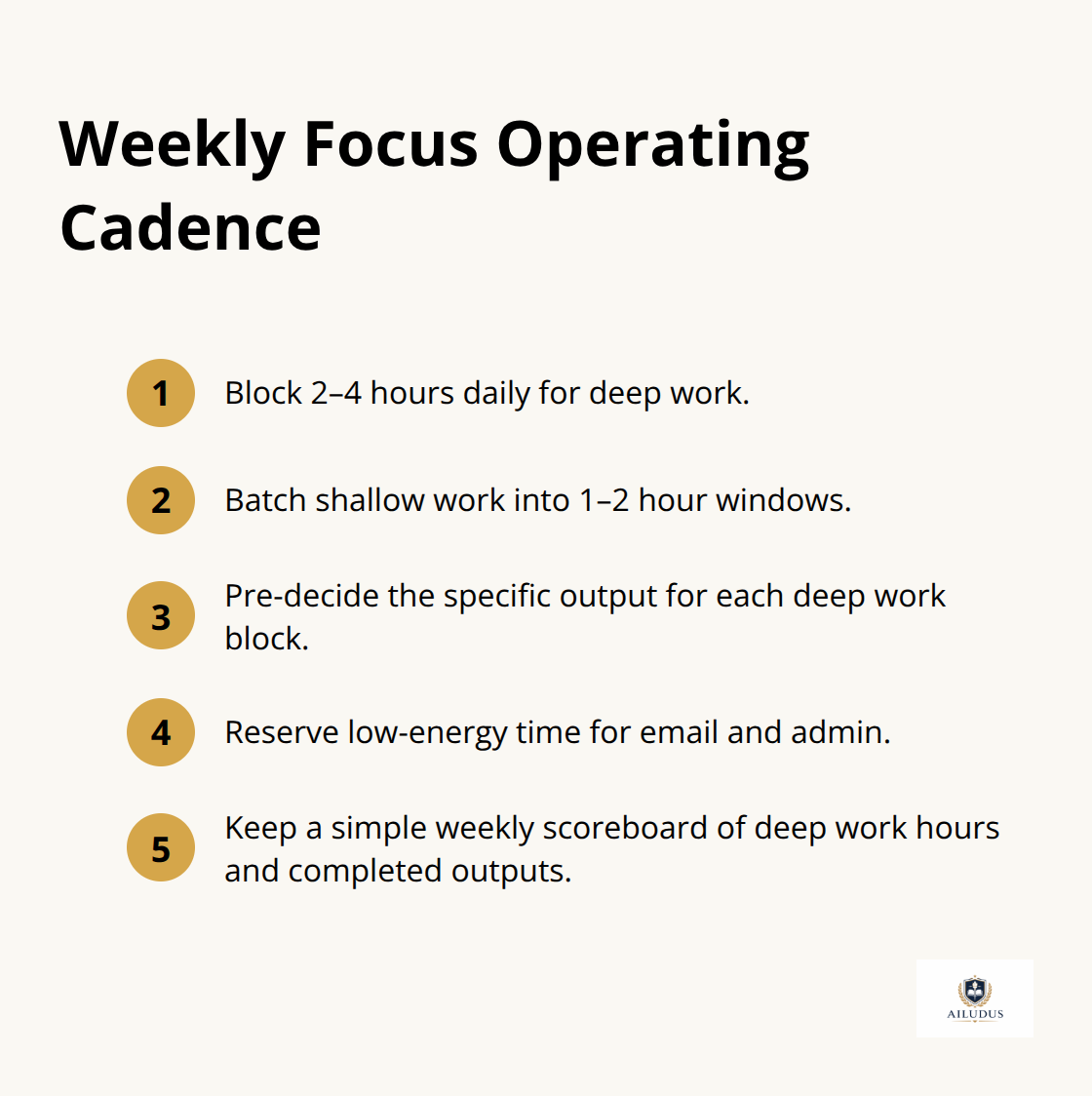
Within deep work blocks, further pre-decide what specific output you’re pursuing. Instead of opening your editor and wondering what to build, you arrive with a concrete, measurable objective: complete the authentication module, draft the customer research summary, or refactor the payment flow. The Four Disciplines of Execution, applied to personal work, recommends focusing on wildly important goals, acting on lead measures like hours in deep work, and maintaining a scoreboard of progress. A simple tracker showing your weekly deep work hours and completed outputs creates accountability without surveillance.
Additionally, establish decision rules for shallow work. How long do you allow for email responses? What triggers a meeting versus asynchronous communication? Do you respond to Slack within business hours or only during designated windows? Written rules prevent decision-making from eroding your boundaries. When you have a rule, you follow it; when you don’t, you negotiate with yourself every time, and you lose.
Batching Work by Cognitive Load
Not all work demands equal focus. Writing requires different cognitive resources than reviewing code, which differs from strategic planning. Most builders sequence work by urgency or availability rather than cognitive demand, which guarantees shallow output on your hardest tasks. Instead, map your work by cognitive load and sequence accordingly.
Identify your peak cognitive hours-for most people, 2–4 hours within the first half of the day. Schedule your highest-leverage, most cognitively demanding work in this window. After peak hours fade, typically early afternoon, shift to moderate-demand work: code review, structured communication, routine problem-solving. Reserve your lowest-energy windows for shallow work: email, administrative tasks, and logistics. This alignment between energy state and task demand is not optimization theater; it’s the difference between producing substantive work and producing activity that looks like work.
Additionally, batch similar tasks within shallow work windows. Process all email in one session rather than checking throughout the day. Return all Slack messages in one block. Handle all administrative work in one window. Batching reduces context switching and makes shallow work genuinely shallow-you concentrate low-demand tasks instead of fragmenting focus. Within deep work blocks, consider task-specific sequencing. Some builders warm up with easier versions of hard problems; others need to start with the hardest piece to establish momentum. Experiment with your own rhythm rather than following generic advice. Track what sequences produce your best output and repeat it. Over four weeks, you’ll establish reliable patterns that become automatic, reducing decision load further and compounding your focus capacity.
The systems you’ve now built-environmental protection, decision pre-commitment, and cognitive sequencing-create the conditions for sustained output. But systems alone don’t compound leverage. What matters next is how you structure the work itself to create repeatable processes that scale beyond your own effort.
Leverage Through Disciplined Output
Systems protect your focus, but focus alone doesn’t scale. What scales is the work itself-specifically, how you structure processes so they produce consistent output without proportional increases in effort. The difference between a builder who ships 10 projects annually and one who ships 50 isn’t raw hours worked; it’s whether the work is repeatable.
Creating Repeatable Processes That Scale
Ramírez and Nembhard’s research on knowledge worker productivity identifies that knowledge work lacks fixed production standards, which means each project typically starts from zero. This is the leverage problem. You solve it by identifying the repeatable components within your work and systematizing them.
A software engineer who builds custom features for clients can document their discovery process, design patterns, and testing sequences into a repeatable workflow. A strategist who conducts research can create templates for research frameworks, analysis structures, and presentation formats. A content creator can establish templates for research, outline structures, and editing checklists.
Map your actual work for one week. Track every significant output you produce-not hours, but deliverables. Identify which steps repeat across projects. You’ll find that 60-70% of your work follows patterns, even if you’ve never formalized them. Document these patterns. Write down the exact sequence, decision points, and quality checks. Make it mechanical enough that a junior collaborator could follow it with minimal supervision. This isn’t bureaucracy; it’s leverage. Once a process is documented, you can delegate it, batch it, or automate it. Without documentation, every project consumes your full attention.
Measuring What Actually Moves the Needle
Most builders measure productivity as activity-emails sent, meetings held, lines of code written. This is measurement theater. What actually matters is whether the output moves your business forward.
Define what moves the needle and measure only that. If you’re a consultant, does a discovery call move the needle, or does a completed proposal? If you’re building a product, does a feature shipped move the needle, or does customer adoption? If you’re an agency, does project completion move the needle, or does client retention and referral? Identify 2-3 metrics that directly correlate with revenue, customer value, or strategic progress. Track only those. Everything else is noise.
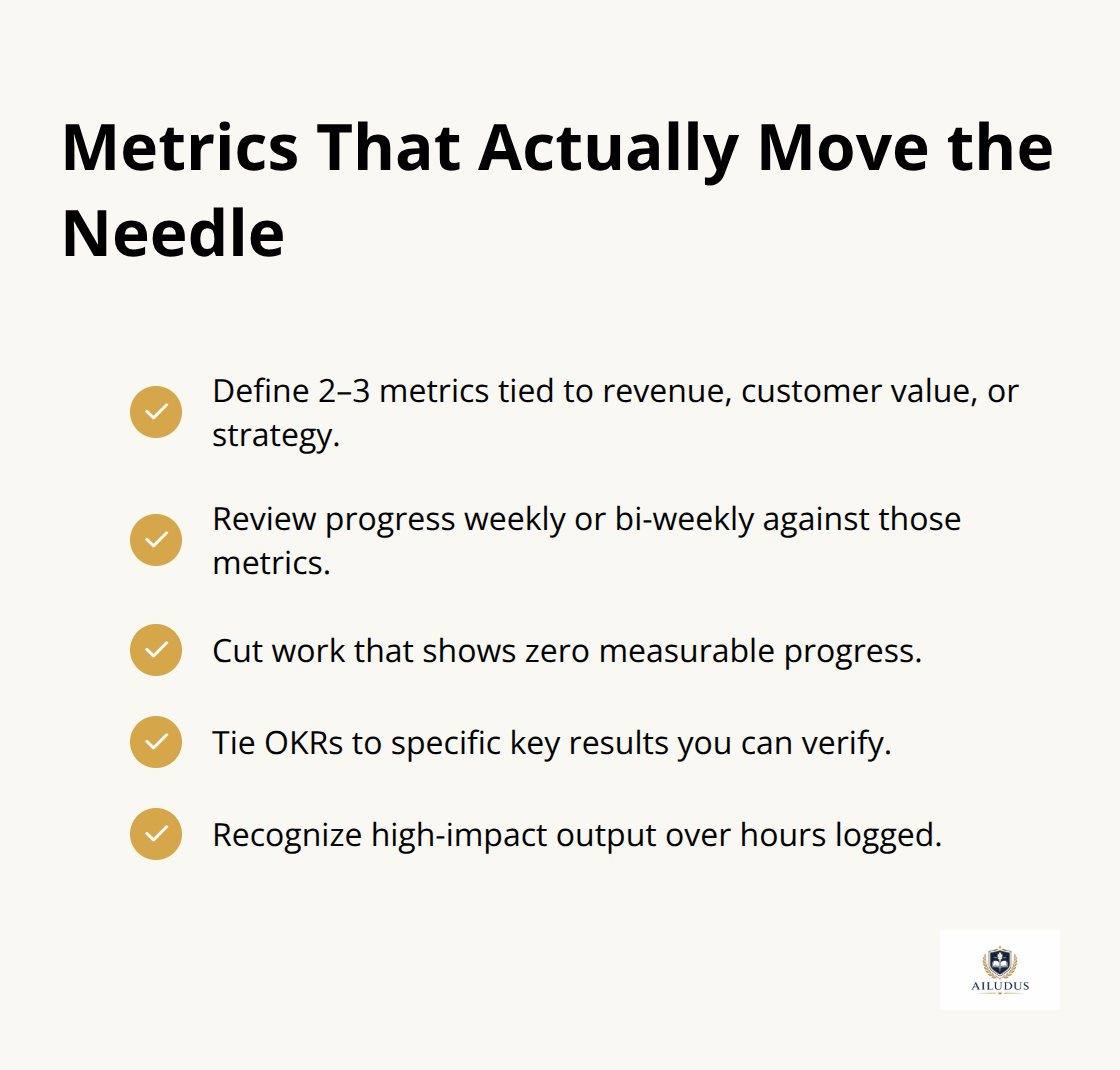
OKRs (Objectives and Key Results) provide a practical framework: set a strategic objective, define 3-5 measurable key results tied to that objective, and review progress weekly or bi-weekly. The discipline is brutal because it exposes work that feels productive but creates no value. You’ll likely discover that 30-40% of your effort produces zero measurable progress. Cut it. Redirect that time toward outputs that actually move the needle.
Building Ownership Into Your Workflow
Make results visible and personal through clear ownership. Don’t distribute responsibility across a team without clear ownership. Assign each significant output to one person. That person is accountable for the result, not the effort. This distinction matters enormously.
When someone owns a result, they optimize for that outcome rather than activity. They ask themselves: what’s the fastest, highest-quality path to this result? That question drives leverage. Conduct weekly or bi-weekly progress reviews where the owner presents what was completed, what remains, and what blockers exist. This isn’t surveillance; it’s feedback and course correction.
Use time-tracking data to see where time actually went, but frame it around results, not hours. A team member who ships a critical feature in 15 hours isn’t underworking; they’re executing efficiently. A team member who spends 40 hours with no completed output is the problem. Shift your feedback and recognition toward quality and impact. When someone delivers exceptional results, acknowledge it explicitly. When someone logs high hours with low output, address it directly. Over time, this creates a culture where output is the measure of contribution, not availability or activity.
The systems you’ve built-repeatable processes, outcome-focused measurement, and ownership clarity-compound across time. Your leverage doesn’t come from working harder. It comes from working smarter, which means automating the repeatable, measuring the meaningful, and owning the results.
Final Thoughts
Modern work discipline separates builders who compound leverage from those trapped in perpetual activity. The systems you’ve built throughout this post-attention protection, decision pre-commitment, repeatable processes, and outcome measurement-only work when you treat them as non-negotiable structure, not optional optimization. Discipline is foundational; it’s the decision to design your environment, sequence your tasks by cognitive demand, and measure results instead of hours.
The productivity culture you’ve inherited tells you that more tools, more tracking, and more optimization will solve the problem. What actually solves it is ruthless clarity about what moves the needle, relentless protection of your focus time, and the discipline to eliminate everything else. This requires saying no to meetings, to requests, and to the constant pull of shallow work, which means you build systems that make the right choice the default choice.
Sustainable growth comes from repeatable processes that produce consistent output without proportional increases in effort. We at Ailudus help builders design operating systems that turn discipline into leverage. Start by auditing your actual focus time this week-track it, and you’ll likely find it’s lower than you think. That gap is your leverage opportunity.
— Published by Ailudus, the operating system for modern builders.